Things I've built
and shipped.
I build things. Not as a side hobby — because the only way to give useful advice about AI is to be someone who's actually wrestled with it. These are the projects that came out of that.
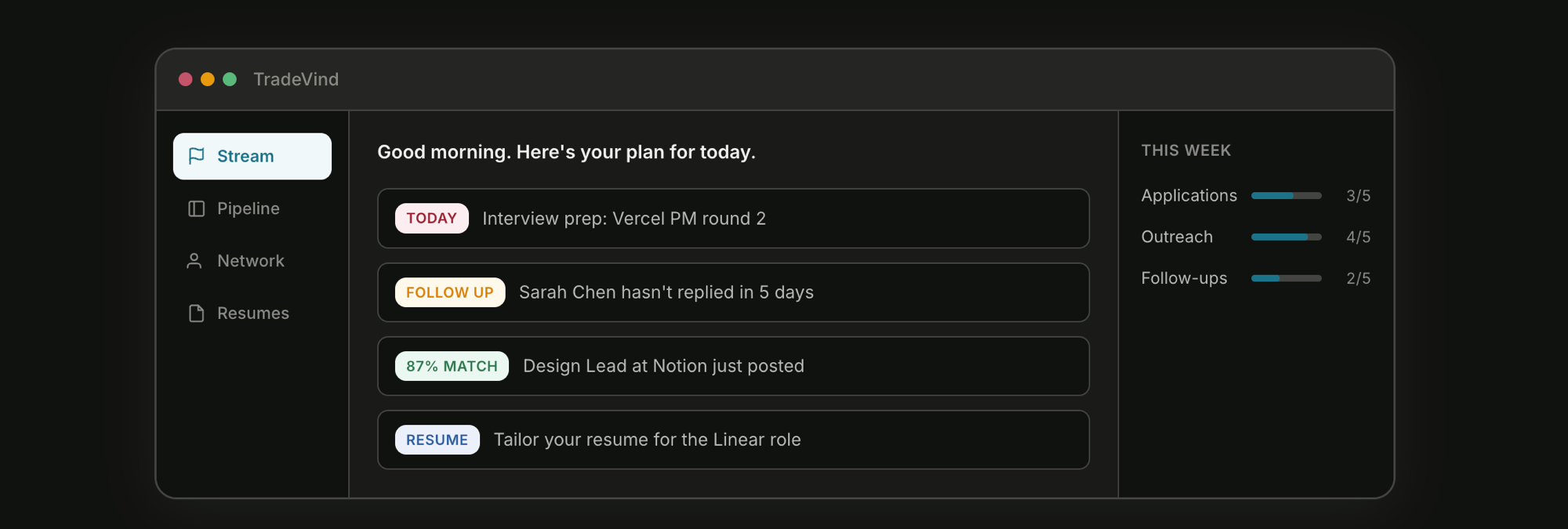
TradeVind
AI-Powered Job Search CRM
Overview
Managing an executive job search is surprisingly hard. You're juggling dozens of companies, tracking conversations across email and LinkedIn, trying to remember what you said to whom — and doing all of this while staying sane in a process that's inherently stressful. Nothing on the market actually handles it. Most tools are either too generic or built for recruiters, not candidates.
So I built TradeVind. I have no formal engineering background — this was nights and weekends, figuring things out as I went. V1 ran on Firebase and got me to a working product. I migrated the whole thing to Vercel for V2 when I needed better performance and deploy control.
The app now includes AI-powered opportunity scoring, contact and conversation tracking, AI-assisted outreach drafting, AI interview practice (you pick a role, it runs you through questions, gives you feedback), a networking tracker, and localization support. It's a real product that I built because I needed it.
Why I built this
Built because I was living the problem. No engineering background — just a clear problem and enough stubbornness to work through it. Nothing else on the market understood what an executive job search actually involves.
Key Features
- → AI-driven opportunity scoring so you stop chasing dead ends
- → Contact and conversation tracking across every channel
- → AI-assisted outreach drafting that sounds like you, not a template
- → AI interview practice — role-specific questions with real feedback
- → Networking tracker with follow-up reminders
- → Localization support for international job searches
- → Firebase → Vercel migration for V2 performance and deploy control
Stack / Context

OpenClaw / Sven
Personal AI Infrastructure · 50+ Custom Skills
Overview
Most people use AI as a fancy search engine. I use it as a cognitive extension of myself.
OpenClaw is the infrastructure — an orchestration system for multi-agent AI workflows. Sven is the persona: an assistant that knows my work, my writing style, my priorities, and how I think. Together they cover 50+ custom skills: strategic research, document drafting, task management, decision support. It's less a tool and more a second brain that actually keeps up.
Why I built this
If I'm going to advise enterprises on AI implementation, I need to be living it myself. OpenClaw/Sven is my laboratory — and honestly, it's also just useful.
Key Features
- → 50+ custom skills spanning research, writing, analysis, and planning
- → Multi-agent orchestration — the right sub-agent for each task
- → Persistent memory so context doesn't reset every session
- → Hooks into external tools and data sources
- → Reasoning patterns for problems that don't have obvious answers
Stack / Context
BPSI Framework
Business Process & Systems Integration for M&A
Overview
M&A integrations fail constantly — not because the deal math was wrong, but because nobody planned for what happens after signing. The operational integration: merging processes, reconciling systems, figuring out whose ERP survives. That's the hard part, and most frameworks skipped it.
I co-authored the BPSI (Business Process & Systems Integration) Framework at PwC to address that gap directly. It's a structured methodology for the phase of integration that most acquirers underestimate until they're already in trouble.
Why I built this
Co-authored because the gap was obvious to anyone who'd run an integration. The methodology for deals existed. The methodology for what comes after didn't.
Key Features
- → End-to-end integration lifecycle from day one through steady state
- → Process mapping and harmonization templates that actually get used
- → Systems rationalization framework — not just "pick one ERP and pray"
- → Change management woven into the integration tracks
- → Governance and escalation models for integration PMOs
Stack / Context
What this means in practice
When I sit down with a client to talk AI strategy, I'm not reading from a framework I learned at a conference. I've hit the walls, debugged the edge cases, and figured out what actually works at the implementation level. That context changes the conversation.